Overview
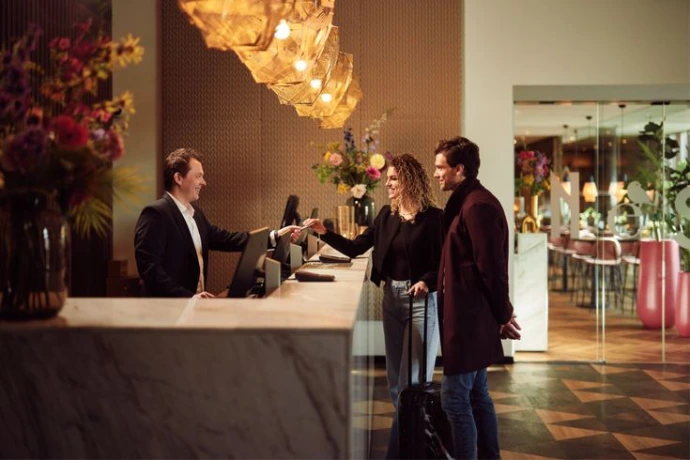
The inner workings of a hotel are complex and involve a great many people, but it is the front-of-house team that guests meet first. As the guardian of the hotel’s image, the front office manager oversees the guest experience, taking care of guests from the moment they arrive (check-in) until they leave (check-out).
What is a front office manager?
In France, the hotel industry accounts for close to 18,000 establishments and slightly more than 170,000 employees. After retail, transport, construction, finance, insurance and communications, hospitality is among the sectors that employ the most people. Whether they work in the industry’s busiest regions, such as Île-de-France, Auvergne-Rhône-Alpes and Provence-Alpes-Côte d’Azur, or elsewhere in France, hospitality professionals fill a wide range of roles. They include the front office manager, who, supported by the team they lead, welcomes, advises and looks after guests as they arrive and throughout their stay.
The front office manager is responsible for looking after guests throughout their stay at the hotel. A true conductor of the orchestra, they are the right hand of the hotel manager in properties with fewer than 100 rooms, and of the rooms division manager in luxury and upmarket hotels.
What does a front office manager do?
As the title suggests, the front office manager welcomes guests on arrival and introduces them to the full range of services available, so that every stay can be tailored to the individual. Their role begins well before guests set foot in the hotel, however, as they also anticipate future arrivals by managing booking requests.
Day to day, they attend to the small details that keep guests comfortable. Alongside managing room occupancy and scheduling the various on-site services, they handle billing and take payment when guests depart. They also keep the department’s accounts on a daily basis.
In smaller hotels, the front office manager runs the entire reception and guest information service. In larger establishments, they head a team of receptionists and night auditors. They supervise and coordinate the team’s work to keep the department running smoothly, drawing up rotas and setting procedures that must be followed to the letter. Where meetings with the team are not possible, they keep a handover log so that members of the department can pass on new tasks at every change of shift. This is known as “carrying out a handover”. Naturally, the front office manager is also responsible for recruiting and training new arrivals.
Another side of the role focuses on building and maintaining commercial partnerships. Working with the sales and marketing department, the front office manager liaises regularly with organisations that generate bookings, such as central reservation offices and travel agencies, both high street and online. Promoting the hotel to travel industry professionals is an integral part of managing occupancy. With the agreement of the general management, sales, marketing and revenue management teams, they recommend rate adjustments to keep pace with the competition, and they regularly review competitor monitoring reports in order to stay in step with the market.
Finally, in the wake of digital transformation, the front office manager must also protect the hotel’s online reputation. Again in collaboration with the general management, sales and marketing teams, they keep an eye on comments left on social media and the various online review sites. Online or on site, they handle every complaint made to their department, before, during and after the stay.
What skills & qualities does a front office manager need?
Organisation, reliability, thoroughness, warmth and a talent for guest relations: that, in essence, is the front office manager. But there is more to it than that. This hospitality professional needs a genuine gift for welcoming people and exceptional interpersonal skills in order to build guest loyalty. Strong spoken and written communication, combined with fluency in several foreign languages, is the key to success in this management role.
Leading a team, they will do well to show a degree of authority while remaining diplomatic, an asset that proves particularly valuable when handling conflict, whether among colleagues or in the face of guest dissatisfaction. Discreet and attentive to detail, their polished appearance reflects well on the hotel, since they are one of the public’s first points of contact with the property.
With a keen commercial instinct, they know when to offer the hotel’s services to guests and how to seize opportunities with new travel industry partners. A natural manager, they have a solid grounding in accounting. As in other hospitality and catering roles, working as a front office manager means accepting hours that do not always suit family life, and sometimes working weekends and even public holidays. Flexibility and a reasonable tolerance for pressure are therefore recommended.
What career prospects and salary can a front office manager expect?
After several years of dedicated service, a front office manager can expect to move into a management position. In a small hotel, the role of hotel manager is a realistic goal; in a large hotel group, they may aim to become rooms division manager.
A front office manager’s salary generally ranges between €2,000 and €3,000 gross per month. That said, the size and success of the hotel, along with the level of responsibility the role carries, have a considerable bearing on their pay.
How do you become a front office manager?
Several training routes can lead to a career as a front office manager.
- Bac +5: a maîtrise, a master’s degree or an MBA from a hospitality business school, such as the CMH qualification “MBA International Hospitality and Luxury Brand Management”
- Bac +3: a bachelor’s degree in hospitality and catering, or a hospitality business school with an international focus, such as the CMH qualification “European Bachelor in Hotel and Tourism Management”
CMH offers a Programme Grande École open to students straight after the baccalaureate and through direct entry, leading to the “MBA International Hospitality and Luxury Brand Management” qualification. Over five years, the school awards an RNCP Level 7 qualification, preparing students to become the managers of tomorrow’s luxury establishments.
Studying on a work-study programme can add real value to your CV, as all of these courses need to be complemented by several periods of professional experience within a hotel before you can take on the responsibilities of a front office manager.